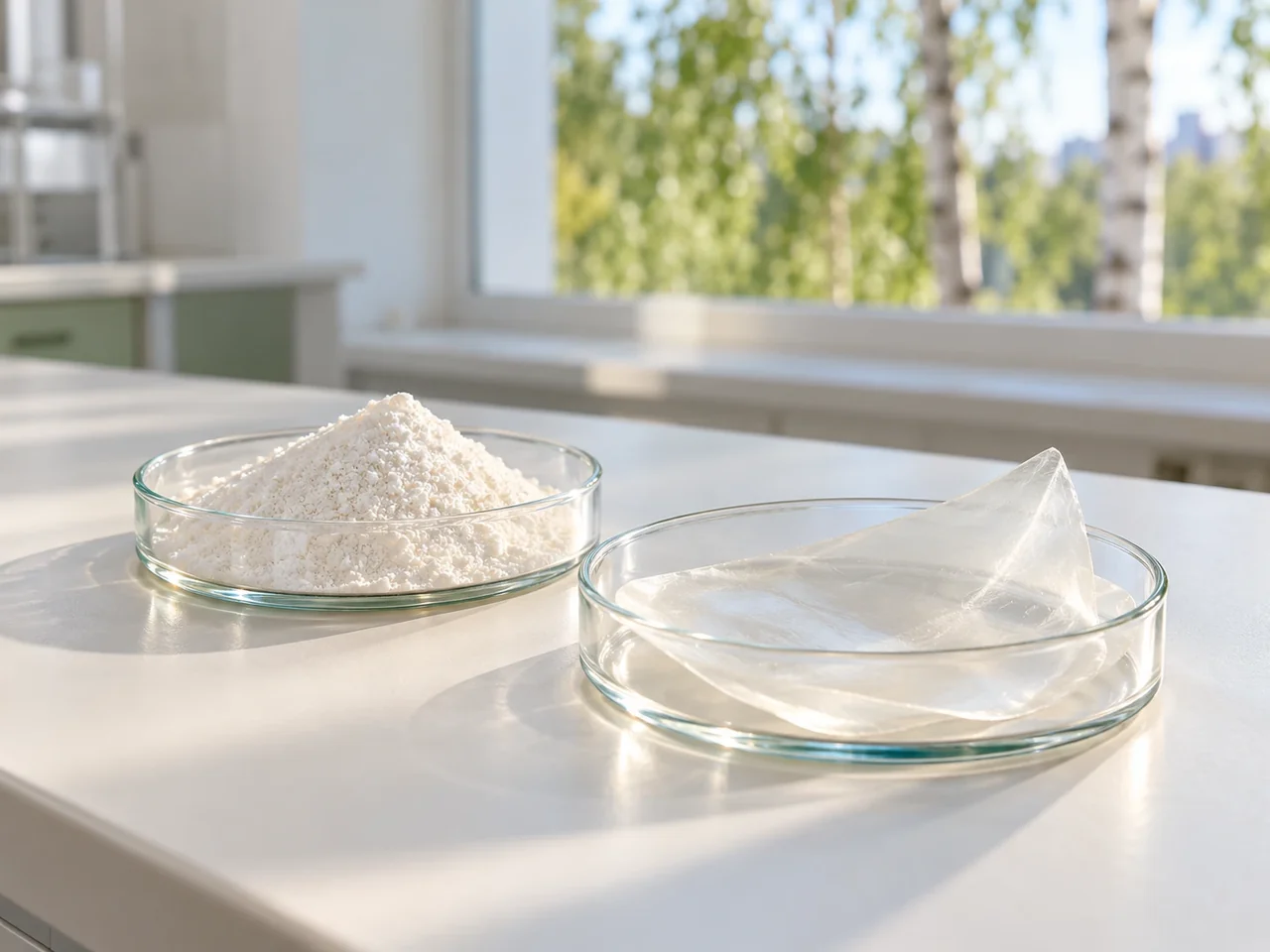
The gifts of the sea—chitin and chitosan—caught scientists' attention almost 200 years ago. Chitin was discovered in 1811 and chitosan in 1859. Its more intensive development began later, as shown by materials from international chitosan conferences held since 1977. After 1985, the number of reports on applications of this remarkable product rose sharply. Today, interest in chitosan is growing rapidly year by year, and the field now includes some of the world's largest corporations, which had not previously worked with natural compounds or even with chemistry.
What is chitin?
Chitin (French chitine, from Ancient Greek chiton — garment, skin, shell) is a high-molecular-weight linear polysaccharide. In combination with proteins, melanins, and minerals, it forms the hard outer covering and internal supporting structures of insects and crustaceans; it is also part of the cell wall of fungi and bacteria. In other words, chitin is a natural substance that protects living organisms from harmful effects.
Chitin is the second most abundant substance in nature after cellulose, and their chemical structures are very similar.
Today, chitin is obtained mainly from the shells of crustaceans. In Russia, the main sources of chitin are the Kamchatka crab, snow crab, and the shrimp Pandalus borealis, which lives in the Barents Sea. Chitosan is the main derivative of chitin.
What is chitosan?
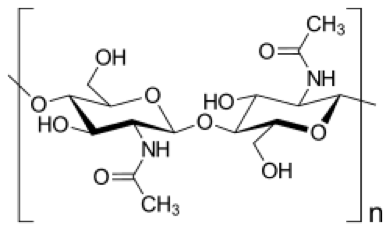
Chitosan is a bioactive cationic polysaccharide whose monomer is N-acetyl-1,4-β-D-glucopyranosamine. It is obtained only from chitin by intensive treatment with alkaline solutions.
The repeating unit of chitosan can be represented by the formula:
Chitosan has antibacterial, antifungal, antioxidant, antidiabetic, anti-inflammatory, and anticancer properties; it can also lower blood cholesterol. Its characteristics include biocompatibility, non-toxicity, low allergenicity, and biodegradability.
Chitosan is widely used in the following fields:
- Medicine
- Agriculture
- The textile industry
- The food and dairy industries
- Water treatment
A chitosan molecule is a long chain made up of many hexose (monomer) rings, numbering in the tens of millions; therefore, this biopolymer does not dissolve in water or get absorbed in the intestine, and acts as a powerful sorbent. Because of its strong sorption properties, chitosan resembles a long freight train that carries not only harmful but also beneficial substances out of the intestine, subjecting the body to a complete clean-out. In some cases, this kind of “clean-out” makes sense, but often it causes significant harm to the human body. Thus, chitosan is a water-insoluble sorbent that does not participate fully in the body's metabolic processes.
What are chitosan oligosaccharides, and how do they differ from chitosan?
To participate actively in metabolic processes, water-soluble forms of chitosan are needed. When taken orally, they can readily pass through the intestinal wall into the bloodstream and actively help prevent metabolic disorders. To obtain water-soluble forms of chitosan, its long polymer chain (with n=∞ units) must be broken into short oligomers (small molecules, n<20) by natural enzymes. This produces low-molecular-weight, water-soluble forms of chitosan called chitosan oligosaccharides.
Chitosan oligosaccharides are structurally similar to the oligosaccharides in human breast milk. As a completely natural product, they are biocompatible with human tissues (connective and cartilage tissues); when taken orally they pass freely through the intestinal wall, and when applied externally they pass through the skin.
With their chelating (binding) properties, chitosan oligosaccharides act as a powerful transport vehicle capable of delivering vitamins, amino acids, medicines, macro- and microelements, and other necessary substances into the bloodstream. Chitosan oligosaccharides can deliver even the most difficult-to-absorb beneficial substances into the body, down to the cellular level.
Japanese specialists believe that in two or three decades, industrial civilisation will be inconceivable without chitosan, just as it is now inconceivable without aluminium, polyethylene, or the personal computer; they also believe that the profitability and turnover of this industry will soon exceed those of the pulp and paper industry.